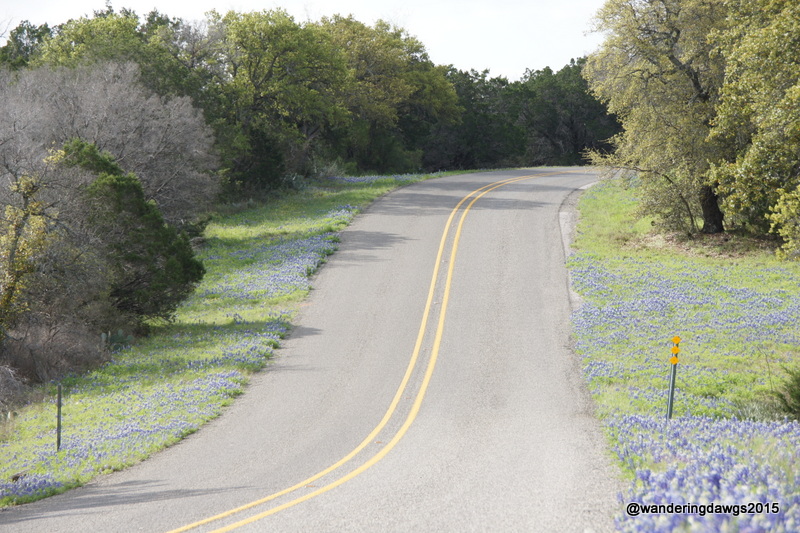
More of the beautiful Texas Hill Country around Inks Lake

Bluebonnets lined the roads around Inks Lake

Inks Lake State Park in Burnet (pronounced BURN-it DERN it) was our home for the 4 nights before Easter weekend. Thanks to my friend Tim in Arlington for recommending this park.

We arrived early in the day and were able to get a beautiful waterfront site. The bad news is we would have to leave on Good Friday because the park was full for Easter weekend. I knew we would love the area when we saw bluebonnets lining the roads to the park.

Our waterfront campsite was a great place to watch ducks, geese and all the water activities. We saw people paddling canoes and kayaks, floating on tubes,  and fishing from motor boats. The sunsets were gorgeous.

I love talking to locals to find out the best places to see. We stopped at Longhorn Caverns State Park one morning to ask about the tours. The ranger had seen me taking pictures of bluebonnets beside the road and he told us about a great scenic drive south of Llano. We were headed to Llano for lunch so we were off on a bluebonnet hunt after we stuffed ourselves with brisket and ribs.
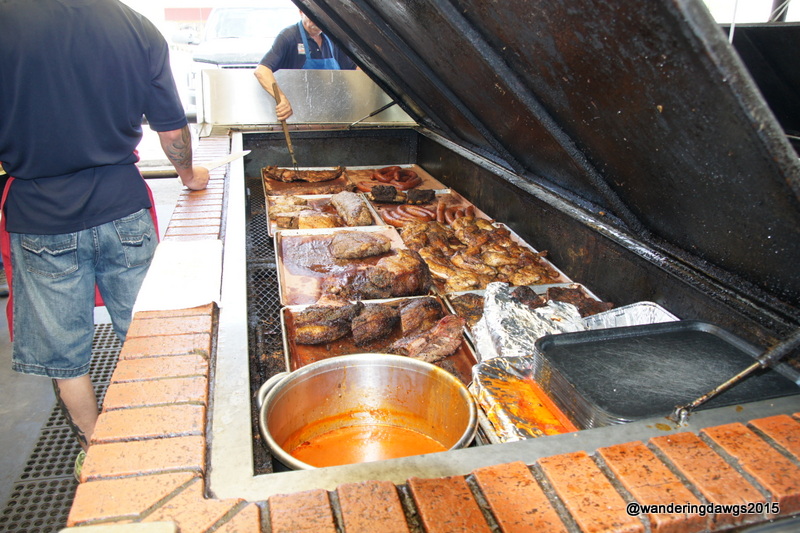
Cooper's Barbeque in Llano, Texas
Cooper’s Barbeque in Llano, Texas

One afternoon we toured nearby Longhorn Caverns. During prohibition the cavern was privately owned and the cavern was run as a honky tonk and restaurant. In one of the large rooms was a bandstand with tables set up all around. When prohibition was repealed the owner gave the land to the state of Texas.

One morning we took a hike on the Valley Spring trail in the state park. The trail started out beside the lake and wound through the woods with wildflowers growing beneath the trees.

Inks Lake State Park has moved up near the top of my list of favorite state parks. Our site was a back in paved pad with water and electric hookups, a picnic table, fire ring, and lantern hook. We had a huge area beneath shade trees to set up our chairs and watch the world go by. There are two fishing piers, a marina and boat launch, canoe and kayak rentals, playground, camp store,  and several hiking trails. Click to read my campground review of Inks Lake State Park.

Exploring the Texas Hill Country around Canyon Lake

There is so much to see and do in the Texas Hill Country we could have stayed a month and not seen in all. Unfortunately, we only had about two weeks to explore this beautiful area in the heart of Texas. The hill country includes San Antonio and Austin and extends west about 200 miles. Driving through the area on mostly twisting, two lane roads we saw canyons and creeks, dance halls and wineries, historic sites and ranches, quaint small towns and old homesteads, green grass and more wildflowers than I ever imagined. We dined on barbeque and schnitzel and I bought a cowboy hat!

Our first home base in the hill country was Cranes Mill, a beautiful Corps of Engineers park on Canyon Lake near New Braunfels. We enjoyed driving on the country roads to explore the area. The bluebonnets were really starting to bloom and we saw more and more each day.

The first order of business was to eat some Texas Barbeque. One of my brothers lived in San Antonio for a few years and told us not to miss the Salt Lick in Driftwood, Texas. We started out our first full day in the hill country driving the back roads to have our first taste of brisket, ribs, sausage and turkey. After our delicious lunch we stopped to visit the Dr. Joseph Pound homestead. Dr. Pound and his family settled there in 1853 and raised 9 children. His descendants lived in the home continuously until 1983.

On a beautiful sunny Friday we took a drive to Luckenbach and a winery near Fredericksburg.

We enjoyed touring the LBJ State Park and Historic Site in Stonewall. Lyndon  Johnson was our 36th president and spent much of his presidency at his ranch on the Perdanales River. Adjacent to the ranch is the Sauer-Beckmann Living History Farm, a working farm which recreates a Hill Country farm at the turn of the 20th century.

The driving tour of his ranch goes around the air strip where he would land in a small plane he called Air Force One Half because Air Force One was too large to land on the landing strip. President Johnson left the ranch to be enjoyed by all the people so there is no charge to tour the park.

We also enjoyed visiting some of the towns in the area. Many of the older buildings in the hill country are made of stone because of the lack of wood for building.

On a sunny Palm Sunday we strolled through the town of Gruene where we enjoyed music at one of the oldest dance halls in Texas. Our Sunday drive continued to the artistic town of Wimberley and a walk along the banks of the Cypress Creek.

While driving around we passed many interesting ranches and the Albert Dance Hall and Twin Sisters Dance Hall. Although we were still a little early to see the bluebonnets in all their glory we enjoyed seeing patches of them beside the roads.

When we weren’t sightseeing we enjoyed our large lake front campsite at Crane’s Mill.

Starting the Lonesome Dove Cattle Trail

“Yesterday’s gone on down the river and you can’t get it back.” – Captain Augustus McCrae to July Johnson, from “Lonesome Dove” by Larry McMurtry.

“If you want one thing too much it’s likely to be a disappointment. The healthy way is to learn to like the everyday things, like soft beds and buttermilk—and feisty gentlemen.”  – Captain Augustus McCrae to Lorena, from “Lonesome Dove” by Larry McMurtry.

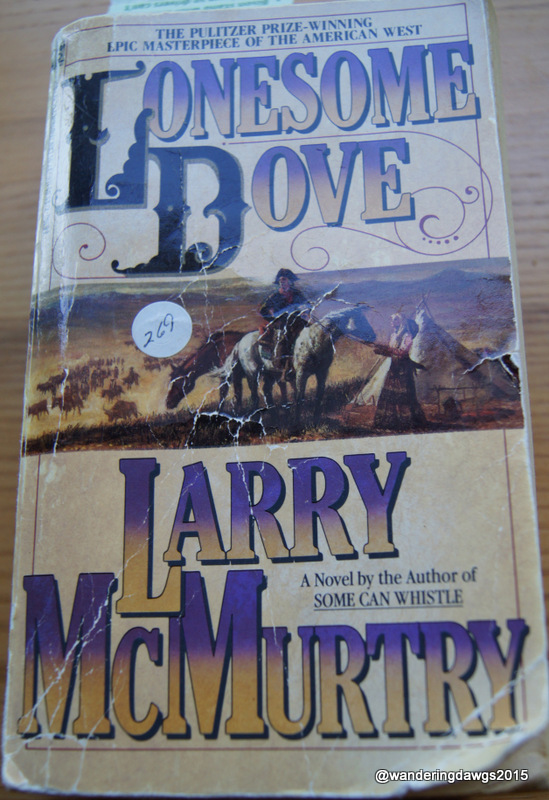
Our dog eared copy of Lonesome Dove
Our dog-eared copy of Lonesome Dove

One of my favorite books of all time is Lonesome Dove, the 1985 Pulitzer Prize-winning novel by Larry McMurtry. I am currently reading  it for the third time, and Henry has read it two or three times. We both also love the 1989 TV miniseries starring Robert Duvall as Captain Augustus McCrae and Tommy Lee Jones as Captain Woodrow Call.

In fact, the whole idea for our Lonesome Dove Cattle Trail, Gulf Coast, Cajun Country, Whooping Crane, Bluebonnet and Brisket Tour began over a year ago when we watched the  miniseries for about the third time. As we were watching, the idea of a trip to follow the cattle trail through Texas as far as Ogalalla, Nebraska began to form. Once we started talking about Texas we decided to time it so we could try to see the whooping cranes and bluebonnets. We couldn’t pass by Cajun Country or the Gulf Coast without spending some time there, either.

The story begins at the Hat Creek Cattle Company in the fictional south Texas border town of Lonesome Dove and revolves around the two former Texas Rangers Gus and Call as they lead a cattle drive to Montana.

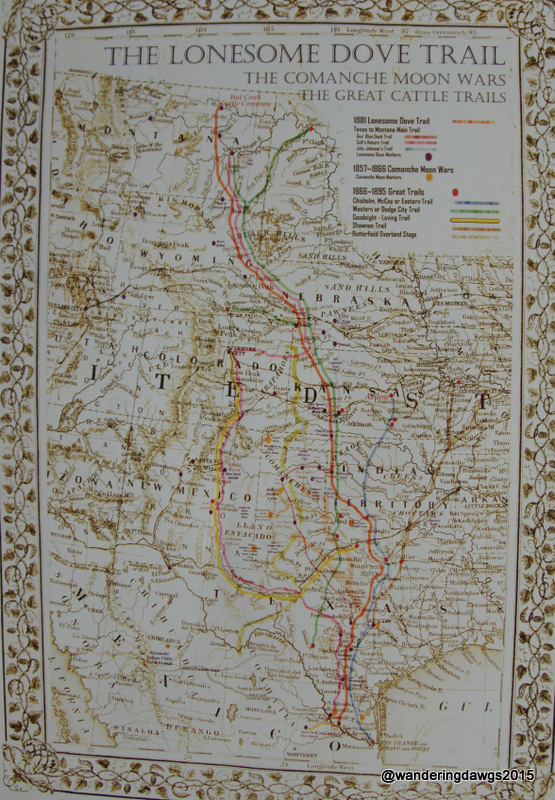
Lonesome Dove Trail Map
Lonesome Dove Trail Map courtesy https://www.etsy.com/shop/AntiqueMapsofTexas

Since Lonesome Dove is a fictional place, we had to do some research to figure out where to start.We studied maps of the cattle trail and the closest place we could find with a nice place to stay was Laredo.

Lake Casa Blanca didn’t exist back then and Laredo doesn’t resemble the dusty, dry town of Lonesome Dove at all. When we left Laredo and started driving north on I-35 towards San Antonio the landscape looked more like it must have looked like to the cowboys. On both sides of the interstate were fields of cactus, mesquite, yucca and dust with few trees in sight. The railroad, which was built following the cattle trail that was used by the real cattlemen, runs beside I-35 most of the way to San Antonio. There are few towns and for miles and miles there was no sign of civilization except the vehicles on the interstate.

We drove through the city of San Antonio (no fun pulling a fifth wheel) and set up camp beside Canyon Lake to explore the Texas Hill Country. When we crossed the Nueces River I could picture the cowboys on their horses herding the cattle across.

In the story of Lonesome Dove several events take place in San Antonio and in and around Austin. Of course, all the places in the story are different now. San Antonio and Austin are big cities and both are surrounded by suburbs, big box stores, strip malls, and outlet malls.

So our plans have changed. As Henry said, it would be disappointing to try to find where a fictional event might have taken place, because we might get there only to find a Home Depot sitting on the location.  Instead of driving through the plains of Kansas and Nebraska  (in the beginning of tornado season), we will spend more time in Texas. We will leave Lonesome Dove in our imagination.

Hey, it’s our trip! The beauty of not making reservations ahead of time is that we can change our plans if we want.


Bluebonnets in Laredo, Texas

We hated to say goodbye to the Texas Gulf coast. Even with the overcast gray skies, fog and rain the whole time we were there we loved it. We knew we would miss the salt air and the sound of the waves from our campsite at Mustang Island but we had lots more of Texas to see.

Miles and Miles of Texas

Our journey from the Gulf took us across miles and miles of Texas to Laredo. On either side of the road were fields of cactus, mesquite and blooming Yucca plants. I spotted the tail of a wolf or coyote going into the brush on my side of the road. Henry and I both saw wild turkeys.

We arrived at Lake Casa Blanca International State Park on a beautiful, SUNNY Sunday afternoon. Finally, blue sky! The park was filled with families enjoying Sunday afternoon picnics.


One of the goals of this trip was to see the Texas bluebonnets in bloom. The state flower of Texas, the bluebonnets usually reach their peak in late March and early April. Texas is the only place in the world where two of the bluebonnet species are found growing naturally.

We didn’t expect to see any blooms until we were farther north in Texas but Mona Liza over at Lowe’s RV Adventures had spotted bluebonnets around Lake Casa Blanca before we arrived. Thanks to her I was on the lookout and found a small patch in the campground and one of the park rangers told us about a patch near one of the picnic areas in the park. The small field was covered with bluebonnets! What an unexpected treat to see bluebonnets so early in our trip!

We spent 2 nights in Lake Casa Blanca International State Park. Our site was a paved pull through with water and electric hookups, a picnic table under a covered shelter, and a fire ring. There were willows and other trees around our site and we could see the lake through the trees. There is a boat launch, fishing pier, and many picnic areas in the park. The park is located near the loop road and close to restaurants and shopping.

Mustang Island State Park, Texas

It rained all night our last night in Goose Island. Our 40 miles trek south to our next Gulf Coast destination included a ride on the Port Aransas ferry. After departing the ferry in Port Aransas we drove south about 12 miles to Mustang Island State Park. Despite rain, fog and overcast skies we enjoyed our stay there.

The first morning the fog was thick as pea soup when I took Blondie for a walk on the beach. After doing laundry there was still no sign of a clear sky so we decided to drive to Port Aransas. We had heard there were some good birding opportunities there and Henry needed to pick up some supplies from a hardware store so he could repair our steps (there’s always something to fix on an RV).

First stop was Charlie’s pasture, a nature preserve. I spied a lone white pelican and a couple of roseate spoonbills across the marsh. The next stop was Leonabelle Turnbull Birding Center where we hit the jackpot. Spoonbills perched in trees, many varieties of ducks, cormorants, American Coot, tri-colored heron, a green heron and many I couldn’t identify. We even saw some turtles.

The next day was still overcast and foggy but we made the drive to Padre Island National Seashore anyway. The park is 60 miles long and extends all the way to the southern tip of Padre Island. The paved road ends shortly past the Visitor’s Center. From there on vehicles must drive on hard packed sand on the beach. Camping is allowed on the beach and we saw some interesting campers as we drove along for a few miles. A picnic table at the windsurfing beach (waterfront campsites with no hookups are available here) was a perfect place for lunch.

We camped in site 17 at Mustang Island. The campground, located just behind the dunes, is a large, rectangular paved parking lot with back in sites on two sides. There is a grassy area between most sites. Each site has water and electric, a shelter with picnic table, and a grill.  There was standing water in some of the sites after a big storm the night before. The water drained overnight and everything was fine the next day. The beach access is a short walk or drive from the campground. There is a large area on the beach with picnic shelters where no driving is allowed. Driving and parking is allowed on the beach on both sides of the beach picnic area.