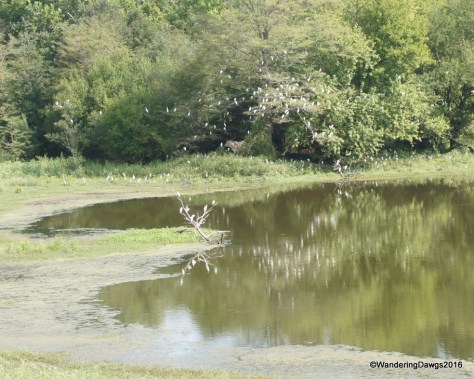
Wood storks, egrets, and herons build their nests every spring in the trees of Woody Pond at the Harris Neck National Wildlife Refuge. Located in Georgia just a few miles from I 95 in between Savannah and Brunswick, it is a great day trip from our home.
Woody Pond at Harris Neck National Wildlife Refuge
Wood storks were placed on the Endangered Species list in 1984. After almost 30 years of conservation efforts to increase the wood stork population, their status was upgraded to Threatened in June, 2014.
A path along the dike beside Woody Pond provides a great place to view the birds. The wood storks and egrets shared the trees.
Wood Storks and Great EgretsNesting Wood Storks and Great Egrets at Woody Pond
Many of the wood storks were working on their nests. None of their eggs had hatched yet.
Wood Storks building a nestWood Stork on nest
As I took photos, Henry used the spotting scope and pointed out a mother egret with chicks that I would have never seen. The nests were a long way from where we were so the picture isn’t the best but it gives you an idea of the size of the baby egret.
Great Egret with chicks
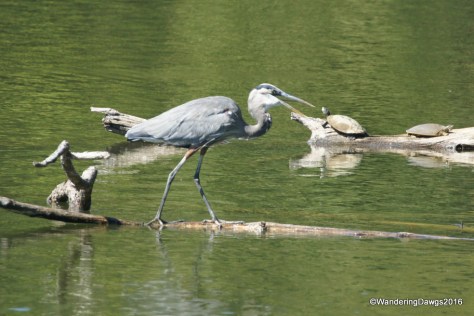
In the shallow water at the edge of the pond a tri-colored heron entertained us as he searched for food.
Tri colored heron
Tri Colored Heron gets his catch
After leaving the refuge we stopped at the Smallest Church in America to take a look and do a little geocaching.
Smallest Church in America
An arsonist burned this church in November, 2015. The church is being rebuilt through the efforts of volunteers and the work is almost complete.
Smallest Church in America, Townsend, Georgia
Smallest Church in America
After finding the geocache hidden near the church we headed for home.
We enjoyed walking around the marina and going on the nature trail at Stephen C. Foster State Park in the Okefenokee National Wildlife Refuge but we wanted to be in a boat to really experience the swamp. On one of our visits a few years ago we rented a canoe to paddle into the swamp and another time we rented a boat to venture even farther into the swamp. On our most recent trip in early spring we decided to take a ranger guided boat tour.
As we glided through the man made canal our guide pointed out the baby alligators and their mother Sophie who was keeping a close watch on her babies. Her mate Zeke was no where to be found.
” Sophie the Mama Gator
As the boat exited the canal we entered the big water of Billy’s Lake where we were about six miles from the headwaters of the Suwanee River. The water here gets up to six feet deep, much deeper than the average depth of two feet.
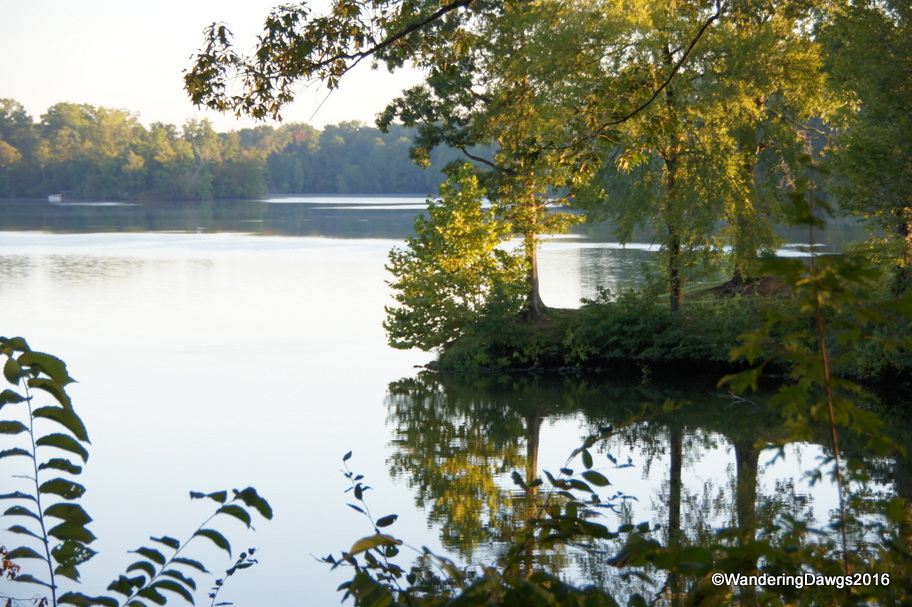
It was a beautiful day to be on the water and we saw a few other people out on the water.
It was a beautiful day for kayakingA kayaker goes around the bend deeper into the swampWhich way do we go?
Our guide took us through the narrow waterway toward Minnie’s Lake. In some places the water was barely wide enough for the 24 foot Carolina Skiff. As we ventured farther into the swamp it was as if we had stepped back in time to a prehistoric age. We were miles from civilization in this incredibly wild place.
Boats had to navigate around this cypress tree
It is estimated that the alligator population in the swamp is about 20,000. We saw quite a few as we went along. It was mating season and I wondered if this gator was trying to attract a mate.
Huge alligator showing us his teeth
Another gator was behind a huge cypress tree.
Do you see the alligator behind the Cypress tree?
And there were young ones sunning on a log.
Young gators enjoying the sunshine
There are many species of wildlife besides alligators. While we didn’t see any raccoons, opossums, turtles, or bears, we did see a few birds out searching for food.
Egret in the OkefenokeeSnowy Egret in the Okefenokee
After our incredible few days in the Okefenokee it was time to return back to civilization and the real world.
On St. Patrick’s Day we left Stephen Foster Folk Culture Center in White Springs, Florida and drove about 50 miles to another park named after the famous composer. At the end of the road 17 miles from the nearest highway, Stephen C. Foster State Park in Fargo, Georgia is located in the Okefenokee National Wildlife Refuge .
This is one of our favorite Georgia state parks and one we have returned to over and over through the years. There is just something I love about being surrounded by nature miles away from civilization.
The Okefenokee Swamp is one of North America’s most unspoiled natural wilderness areas. According to the U. S. Fish and Wildlife Service Okefenokee National Wildlife Refuge web page, “the Okefenokee National Wildlife Refuge has 353,981 acres of National Wilderness Area within the refuge boundaries. In addition, the refuge is a Wetland of International Importance (RAMSAR Convention – 1971) because it is one of the world’s largest intact freshwater ecosystems.”
Indians who once lived in the area called it Okefenokee which roughly translated means “Land of Trembling Water.” The headwaters of the Suwanee River is located in the Okefenokee Swamp.
Going out in a boat is a great way to see the swamp but there is also plenty to see from land. All the photos in this post were taken as we walked around the campground, marina and on the Trembling Earth Nature Trail which starts at the marina. One section of the trail is a boardwalk through the swamp. This huge gator was sunning on a log beside the boardwalk.
Giant gator beside the boardwalk trail
The only man made waterway in the park is this canal which leads to the open water of the Okefenokee Swamp.
Canal leading into the Okefenokee Swamp
The canal runs beside the road and alligators are frequently seen sunning themselves on the bank or chilling in the water.
Alligator among the lily pads
One of the other campers told me about baby alligators beside the road so off we went in search of baby gators.
Baby gator in the canal beside the road. Do you see the one in the water?Baby Gator on Lilly Pad
Besides alligators, many other animals make their home in the Okefenokee.
White Tail Deer at duskWild TurkeyIbis in the swampEgret in the swampButterfly beside the trailTurtle swimming in the marina
Coming up in my next post – a ranger guided boat tour into the Okefenokee.
Our week at Fort Pickens Campground in the Gulf Islands National Seashore sped by. When we weren’t walking on the pure white sand at the beach, exploring Fort Pickens and the batteries, or visiting the National Naval Aviation Museum we were wandering around the Florida Gulf Coast.
One day we took Blondie outside of the National Seashore to go to the Pensacola Beach Dog Beach. A small section of beach has been set aside to allow dogs on a leash to enjoy the beach.
Blondie went for a swim at the Pensacola Beach Dog Beach
A Legendary Beach Bar
One day we took a drive along the Gulf to the Florida-Alabama state line to visit the famous Flora-Bama Bar. The bar has been called the “Last Great American Roadhouse” and ranks among the “Best Beach Bars” in the world. The wooden building is located on the beach between high rises and we almost missed it as we drove along the Gulf road. Originally built in 1964, it has survived fires and hurricanes. After suffering a direct hit from Hurricane Ivan in 2004, the building was restored.
Flora Bama Bar
It was quiet the day we went. Their busy season starts with spring break. Their “Interstate Mullet Toss and Gulf Coast’s Greatest Beach Party” brings huge crowds in April.
Besides the famous beach bar, there are two restaurants, a liquor store, a marina, and plenty of parking across the road on the bay. We enjoyed a lunch of shrimp po’boys at their Old River Bar and Grill overlooking the bay before heading back to our campground.
Flora Bama BarFlora Bama Bar beach side view
Gulf Coast Good Eats
For us, no trip to the Gulf Coast would be complete without a trip to a seafood market. In our quest for Stone Crab Claws we stopped at Joe Patti’s Seafood Market in Pensacola. The huge seafood market has been in business in Pensacola for many years and sells every kind of fresh seafood and related items you can imagine. Iced down in the display cases were fresh grouper, redfish, snapper, other fish, gulf shrimp, scallops, stone crab claws, oysters, and seafood of every kind. Also available are made in house shrimp and other salads, smoked mullet dip, seafood spreads, seafood chowder and other specialty items. Then there were smoked sausages and other specialty meats along with many Cajun specialties. In another room were sauces, condiments, and kitchen items to help prepare and eat the seafood.
The place was packed but we were served quickly and left happy with Jumbo Stone Crab Claws, shrimp salad and smoked mullet dip for dinner. Best meal we had on the entire trip.
Joe Patti Seafood in Pensacola
Located just a short drive from the entrance to the Gulf Islands National Seashore, Peg Leg Pete’s in Pensacola Beach was recommended to us by several of our friends so of course we had to give it a try. Our friends didn’t steer us wrong. The Cajun fried shrimp appetizer and Grouper Sandwiches were excellent.
Peg Leg Pete’s in Pensacola Beach, Florida
Wildlife and Sunset Vewing
Even sitting in our own campsite we were entertained. One day an armidillo walked into our campsite driving Blondie wild.
Armadillo in our campsite
We walked out on the fishing pier at Fort Pickens to see what the fishermen were catching. One fisherman was reeling in a stingray as we arrived and we saw another catching Drum in a cast net. As we walked along the pier a Great Blue Heron walked right in front of me before hopping up on the railing to put on a show. There were actually two herons on the pier and when the first one flew off, another took his place on the railing.
Great Blue Heron
Great Blue Heron
Great Blue Heron
Great Blue Heron
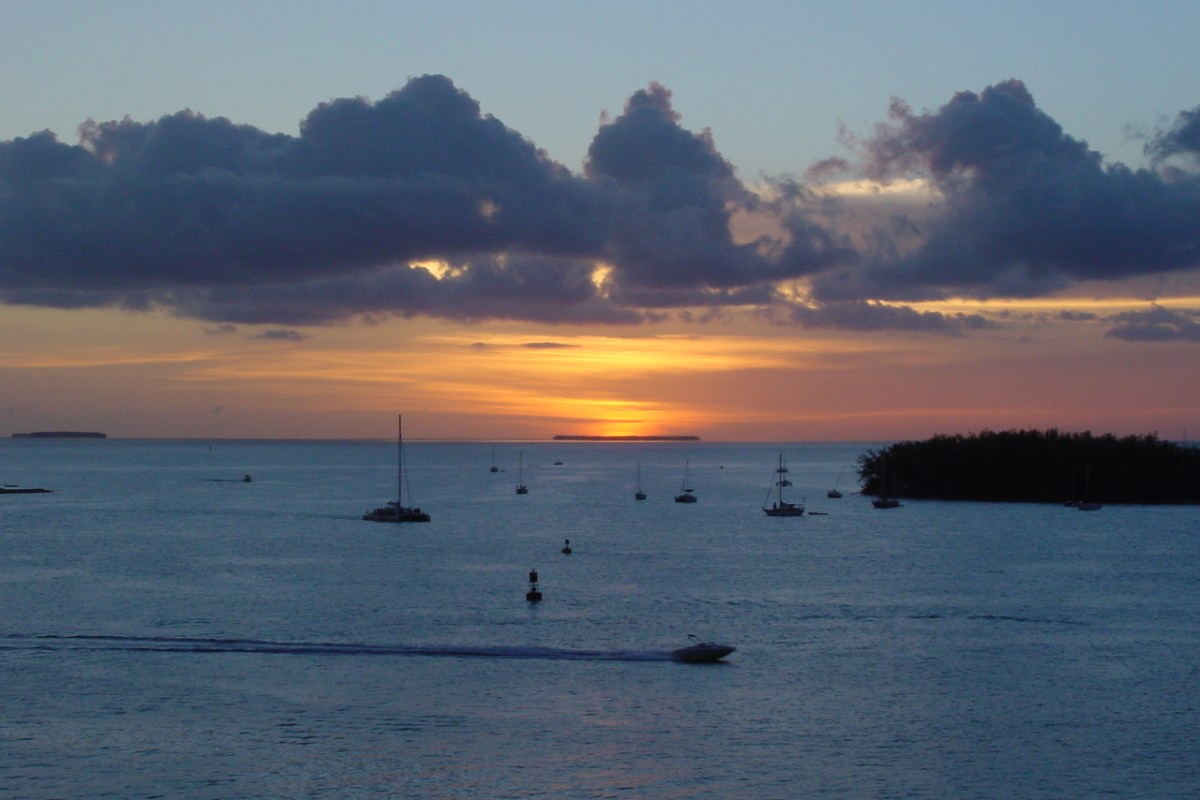
We enjoyed more beautiful sunsets over the Gulf of Mexico.
Sunset over the Gulf
Evacuating the Campground
As the week went on the winds picked up and the waves got bigger.
The seas were getting rough
When you check into the campground at Fort Pickens, you are taking a chance that you may have to leave early because of the road flooding. There is a low section of the road between the campground and the entrance to the park that is subject to flooding. During big storms, the campground has been known to flood. The winds had been picking up all week and storms were forecast starting on Thursday, March 10, our departure date.
On Wednesday afternoon we returned from our wanderings to find a notice on the door to our RV that the campground was closing at noon on Thursday. Several campers left that afternoon while everyone else (like us) started packing up and getting ready for an early morning departure. The luck of the Irish was with us since we were scheduled to leave anyway.
After leaving the campground we drove through a section of the Fort Pickens Road that was underwater.
“The sea, once it casts its spell, holds one in its net of wonder forever.” –Jacques Cousteau
A beach with perfect sugar white sand only a five minute walk from our campsite. I think I am in heaven!
Gulf Islands National Seashore at Ft. PickensThe beach at sunsetGulf Islands National Seashore
Our home for a week is Ft. Pickens Campground in Gulf Islands National Seashore on Santa Rosa Island. I’ve been doing a lot of walking on the beach and beach chair sitting.
Site A1 Ft. PickensReady for Beach Chair Sitting on the Gulf of Mexico
We’ve taken a couple of hikes on the half-mile Blackbird Marsh Nature Trail near the campground.
Along the Blackbird Marsh Nature Trail
It is nest building time for Ospreys and several nests can be seen in the area. Ospreys are frequently seen soaring over the campground and a few of the nests can be viewed close up from the nature trail.
Pair of Ospreys on the nature trailPair of Ospreys on the nature trailOsprey
And the sunsets over the Gulf of Mexico are breathtaking!
Sunset over the Gulf of Mexico
More of the Fort Pickens area coming up in my next post.